
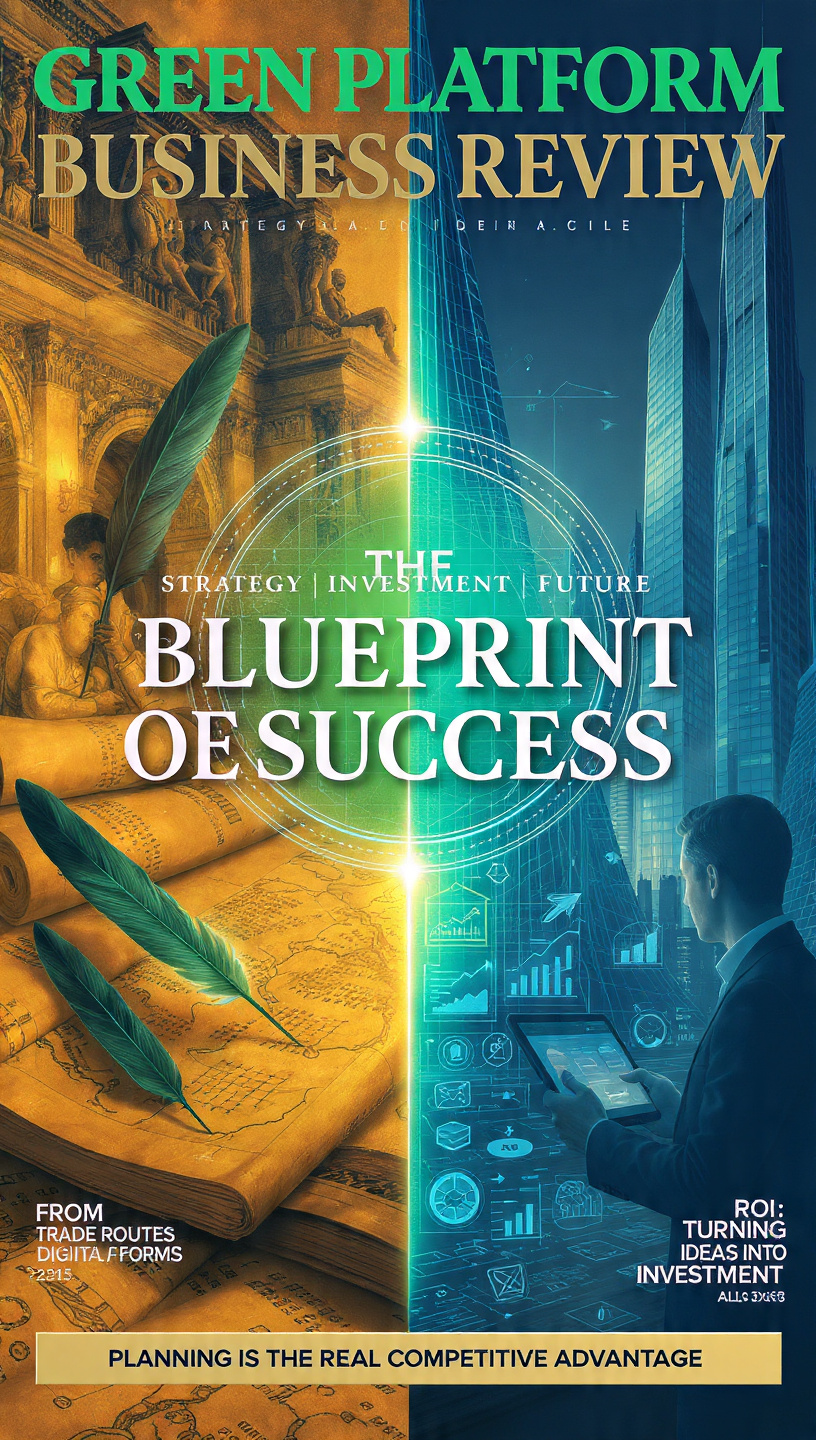
History teaches us a simple truth, civilizations that planned survived — and those that didn’t, faded.
From ancient trading cities to modern financial capitals, progress has never been accidental. Behind every lasting empire, every thriving industry, and every successful company lies preparation, calculation, and vision.
Long before spreadsheets and pitch decks existed, merchants along early trade routes studied demand, assessed risks, and planned their journeys. Kings did not build cities without surveying land. Explorers did not sail without charts. Even the world’s first large corporations, such as the East India Company, relied heavily on forecasting, logistics planning, and economic feasibility to justify massive overseas investments.
Today, we call these practices business planning and feasibility studies — but the principle is ancient.
🧭 The Business Plan, A Map Before the Journey
A business plan is more than a document. It is a roadmap.
It answers fundamental questions:
- What problem are you solving?
- Who are your customers?
- How will you earn revenue?
- What resources do you need?
- How will you grow?
History shows us that even modern capitalism rests on structured planning. In 1776, economist Adam Smith laid the foundations of market economics, emphasizing organization, productivity, and strategic allocation of resources. Those ideas still echo in every startup pitch and corporate strategy today.
Businesses that operate without a plan often move blindly — reacting instead of leading. Costs rise unexpectedly. Markets shift unnoticed. Opportunities pass quietly.
With a plan, founders gain direction. They can measure progress, attract investors, align teams, and make informed decisions. Without it, even brilliant ideas struggle to survive.
🔍 The Feasibility Study, Asking “Should We?” Before “How Do We?”
If a business plan explains how to build, a feasibility study answers something even more important:
Is this worth building at all?
A feasibility study evaluates:
- Market demand
- Financial viability
- Operational requirements
- Legal and technical constraints
- Risk exposure
In history, large infrastructure projects — from railways to factories — were never launched without cost-benefit analysis. Investors demanded proof. Governments required projections. Builders studied terrain.
Skipping feasibility is like constructing a bridge without checking the river beneath it.
When businesses ignore feasibility:
- Capital is wasted
- Time is lost
- Teams burn out
- Investors pull back
When feasibility is done right:
- Risks are identified early
- Resources are optimized
- ROI becomes predictable
- Confidence replaces guesswork
It is the difference between hope and strategy.
🌱 From Ledgers to Digital Platforms: Planning in the Modern Age
Fast forward to today.
Markets move at digital speed. Competition is global. Customers expect transparency. And decisions are increasingly data-driven.
This is where platforms like Green Platform represent the next chapter in business evolution.
Much like historical marketplaces once centralized trade, Green Platform brings together:
- Structured business visibility
- Customer engagement
- Sustainability profiling
- Practical performance insights
It allows entrepreneurs to validate ideas, test visibility, understand engagement, and showcase values — all critical components of modern feasibility and planning.
In essence, Green Platform helps founders answer the same timeless questions merchants asked centuries ago:
Is there demand?
Can this grow?
Will people trust us?
Only now, those answers come through digital signals instead of handwritten ledgers.
🎓 Why Business Management Exists — and Why Students Must Learn It
This brings us to an important modern question:
Why is there a course called Business Management?
Because economies are not built on ideas alone — they are built on returns.
Business Management teaches students how to think in terms of:
- Investment
- Risk
- Strategy
- Operations
- Market behavior
- Return on Investment (ROI)
Every peso, dollar, or hour invested must justify itself.
Students learn how to transform capital into value. How to read financial statements. How to assess feasibility. How to plan growth. How to manage people. How to protect sustainability.
Without this knowledge, investments become emotional decisions instead of strategic ones.
Business Management exists because the world runs on ROI — whether in startups, corporations, or national economies.
It trains future leaders to make decisions that don’t just sound good — but make sense financially.
🧠 Conclusion: Planning Is the Real Competitive Advantage
History doesn’t reward speed alone.
It rewards preparation.
Every successful venture — from early trade empires to today’s digital platforms — followed the same pattern:
Plan first.
Study feasibility.
Invest wisely.
Measure returns.
Adapt continuously.
In the modern era, Green Platform carries this legacy forward by helping businesses gain visibility, validate markets, engage customers, and grow with purpose — turning planning into action and insight into opportunity.
And for students, Business Management is not just a course.
It is training for reality.
Because in business — as in history — those who understand investment and ROI don’t just participate in the economy.
They shape it.